
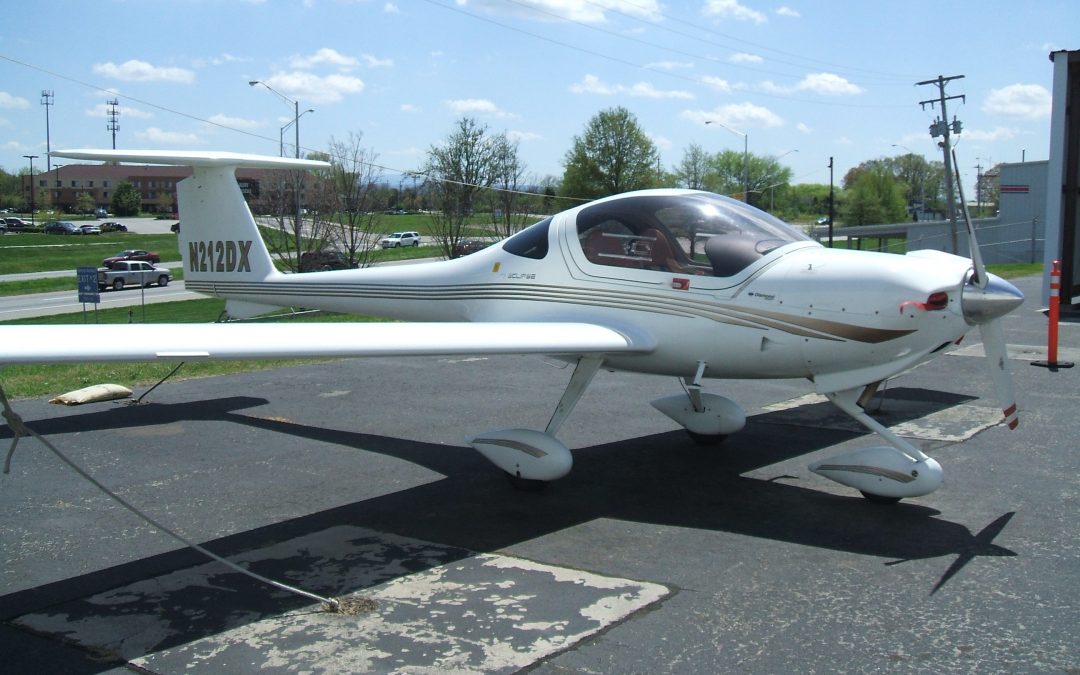
Late in my training my flight school transferred some aircraft to another location and picked up a new 2-place composite trainer, a DA20-C1 Eclipse. It is a slick looking little plane. I new that once I’d completed my check-ride I wanted to get checked out in the DA20, especially considering the new difficulty in getting the sole remaining 172SP.
The DA20 was born from a motorglider, and it shows. On my check out, I pulled the power to idle and pitched for 80 knots about a mile from the airport and I made it to pattern altitude about a half mile past the airport. I brought it around the pattern and managed to plant it nicely on the runway just shy of halfway. We got stopped and I learned how to fully utilize the free-castering nose wheel. The next time around I did better about managing speed and altitude and I actually made a nice short landing. With an equally spectacular climb rate, about 1000 feet per minute, the DA20 will really spoil a Cessna 172 driver.
Let me take this opportunity to address one of the fundamental differences between the 172 and the DA20: the DA20 uses a stick. This was concerning initially, but after about 2.5 seconds I was converted. Almost all of my bad yoke habits were eliminated. Count me as a stick pilot.
I’m given to understand that the 125 HP Continental powered DA20-C1 Eclipse available to me is a far cry from the 80 HP DA20 Katanas that most are familiar with. It’s not a total surprise that 45 extra horsepower would completely change a plane, but it bears consideration when you hear someone dragging the DA20 through the mud. They might be right. I do have to admit that the 125 HP Continental does sound a bit toyish when compared to larger more powerful engines, but it does the job efficiently burning only about 5 gallons per hour at cruise.
The one thing I can say truly surprised me about the airplane is how tiny it looks. I was really surprised when I climbed in at how well it fit though; you just slide in and close the canopy; everything is right there, but it’s not really cramped. One caveat here is that the DA20 is not really a cross-country aircraft; it has virtually no baggage space. If it doesn’t fit in the small space behind your head, you aren’t taking it.
Many DA20s are certified for spins, so you can have a little fun like you can see in the following video. The stall is very controlled and, like the 172, you pretty much have to make trouble for yourself. The ailerons, as small as they are and as little as they move, are effective even well into the stall. The DA20 is just a really nice plane to fly. The only potential problem I’ve found with the DA20 from a training standpoint is that, due to a lack of lightning protection, it cannot be certified for IFR flight.
DA20s can be acquired at relatively reasonable cost. A new DA20-C1 from the factory with Garmin G500 or Aspen glass will run you just shy of $200,000. A reasonably new 2004 or 2005 vintage DA20 runs about half that, but you lose the factory installed glass panels in favor of steam gauges and Garmin 430s or a 530. In my opinion, the best deals are in the late 90s model DA20s. They are basically the same airframe, but at a $40,000 price tag you’re saving $160,000. You could afford to put your own glass panels in, overhaul the interior, and fly for a long time even with today’s fuel prices.